Tuesday, May 8, 2012

Goodbye LBN, phir milenge!


Shortly after my kathak performance, it came time for another culmination, another ending: my last day at Navyug School, Laxmi Bai Nagar. 

In reality, I had finished my actual teaching duties towards the end of February.  I stayed on at school for several more weeks, invigilating for exams.  After exams officially ended, my school duties did as well, as students were not coming to school.  (The other teachers still had to stay and grade though.)  As I had not had any sort of official farewell prior to exams however, the teachers kindly thought to have a small farewell get-together for me in early April.

Though I had not been asked to wear a saree, I felt that I should.  Fortunately, my saree-tying skills have improved a great deal since Teachers’ Day.  Also in my favor was the fact that I had been asked to come to school at 11am, and not 8am.  By the time I had to leave for school, my saree was not perfectly tied, but it was at least on my body.  I waddled carefully to the metro station, and eventually found myself at school.

As soon as I entered the gates a group of smiling teachers greeted me, welcomed me back, and complimented me on my saree.  Once they saw it up close, however, it was quickly determined that I would need some help re-wrapping it.  I was quickly beckoned into a small room off to the side of the Principal’s office, where two of the school’s workers and one teacher got down to the task of dressing me.  There was some admonition about the slipperiness of the fabric I had chosen, but in general, I think we all had a good time getting me dressed.  I certainly learned a lot.  It turns out that I had been doing my pleats wrong for a very long time…

Eventually, I was dressed and ready, and my coordinating teacher fetched me and brought me over to the library, where the get-together was to take place.  There I sat and chatted with various teachers while we waited for the whole faculty to show up.  I realized that my farewell was to be a whole faculty party, while the prefects supervised the students.  It took a while for all members of the faculty to make it into the library, and finally the Principal voiced what I had been thinking: “Let’s start now; how long do you really think the prefects can hold the school together?” 

Waiting in the library: Deepika ma'am and Shubhangi ma'am

Varuna ma'am

Several very nice speeches followed, and I was surprised at how much the teachers remembered, knew, and appreciated about me.  They talked about how I had not only taught the school’s naughtiest children, but had enjoyed doing it; they proudly mentioned that I cooked my own Indian food, and that I had worked hard on the inter-Navyug Sports Day aerobics dance.  They wished me all the best, and of course, expressed their desire to have me married to a nice boy some day soon, preferably in India.  I was also asked to perform a little bit of kathak, which I did to the best of my ability, considering I was wearing a saree.  It was not my best kathak performance, but everyone seemed to enjoy it.

After the speeches and dance, it was time for lunch, which consisted of puri (deep fried flat breads), aloo sabzi (potato curry), raita (yogurt sauce), and halwa (a sweet dish).  All of this was served by the boys of class 9a (formerly class 8a, who featured in my Christmas blog post).  They were unusually quiet and obedient due to the presence of the entire school faculty, but their devilish grins definitely emerged as they served me far too much food.

After lunch I went outside the library where a water cooler had been set up.  I very quickly heard the familiar cries of “Hiiiiiiiiii Abby mam!”  I looked up and the members of class 7b (6b when I taught them) hanging out of their classroom windows, excitedly waving.  At that point I excused myself from the teachers’ gathering and “took a round” around the school, so I could visit with my kids.

It was as crazy as I thought it would be.  “MAAAAM!!!!  Where have you been ma’am?”  “You look gorgeous ma’am!!!”  “Ma’am I think you have taken help with this dress ma’am.”  “Who tied your sari ma’am???”  (How well they know me.)  I think the following pictures will illustrate what the rest of my afternoon was like, much more accurately than any verbal description I might come up with:

An energetic 8b

The energy was contagious!

8b boys

Good-as-gold 9b (there was another teacher in the room)

Sparse 9a (remember, most of the boys were serving food)

7b girls

Best friends

7a boys

8a girls

The disagreement over who would be in front ended in a race towards the camera

8a

The very spirited farewell I received from reminded me again of how much I have learned over the year, about India, education, pedagogy, childhood, and about myself.  Looking back, there are many things I might have done differently, things that would have made my time at Navyug School Laxmi Bai Nagar much easier.  Perhaps if I had “kept more of a distance” between the students and myself, as my Principal had advised, I might have had more luck with discipline.  Maybe saying “no” to the sweet 7th graders who asked “Ma’am…can I hug you ma’am,” might have established automatically that I was far above them hierarchically.  And it is possible that high-fiving the boy who announced that he shared my enthusiasm for movies starring Shah Rukh Khan diminished my teacherliness in my students’ eyes.

During our first week in Delhi, Vinita, the USIEF Director, warned us to be strict with our students, and not to become their friends.  “If you become friends with them…then they will take you on a ride,” she said.  My kids have certainly taken me for a wild ride.  But what a ride it has been…  Over the course of the year I have had the privilege of being invited into some of my students’ homes, where I have been fed generously, been shown family home videos, and had my hands beautifully decorated with henna. 

I have played fast-paced playground games like “ice-water” (freeze tag), chupan chupaai (hide and seek), chiclets (a playground game I have seen only in India), and kho kho, a traditional game that has its roots in the ancient India, but really gathered force in the 1920s.  I was also lucky in that I had a group of 6th grade boys eager to coach me on my cricket bowling technique.  When running games were too hot and tiring, the girls of 6b led me on “nature walks” in the school’s tiny garden, telling me, “We are only small children ma’am, but we have great interest in nature and in saving our Earth.”  And this even after they had given me lengthy explanations of the various native Indian plants, their religious significances, and their nutritional and medicinal properties.

Sometimes I worried that the “cultural exchange” that Fulbright intended was entirely one-way—I often felt that I was learning much, much more than my kids were.  I noticed small changes in my students’ language skills to be sure: they no longer mixed up “good morning” and “good afternoon” for one thing, and quickly stopped interchangeably using the words “he” and “she.”  But were these changes worth all the classroom chaos, the confusion, and—dare I say it?—the U.S. tax dollars? 

In the end though, I really do believe that my time was well-spent.  I certainly grew tremendously over the year, and have many ideas for how to proceed the next time I find myself at the front of a classroom.  My Hindi has improved dramatically, as has my knowledge of Indian culture.  I naturally will never really know if I have made any kind of a difference in my students’ lives.  Still, when I see that the student who has bluntly said, “you have black hair ma’am.  Americans have golden hair” finally understands America’s origins, or when we have a class New York style New Year‘s Celebration which involves counting down from ten, dropping a ball, and singing “Auld Lang Syne,” or when we celebrate Thanksgiving by discussing (in English) the things we are thankful for, I realize that J. William Fulbright intended for the English Teaching Assistantships to be about far more than grammar, vocabulary, and spelling.  As Fulbright himself once said, “Educational exchange can turn nations into people, contributing as no other form of communications can do to the humanizing of international relations.”

When one of my brightest and most enthusiastic students asked me to “do one thing ma’am.  Please don’t go back to America ma’am!” I was reminded of how much more I have to learn about India, and how much more I would like to give back to this country that has so generously hosted me three times.  I told my student that I could not stay any longer this time, but that I would be back.  And I will be.  Pukka

Friday, April 20, 2012

A Year of Kathak

All the way back in August, I wrote a short post about embarking on a course of kathak (North Indian classical dance) lessons.  “More on this soon!”  I wrote.  Well, now finally, I am going to deliver on that promise. 

For several months, I took lessons with the teacher I had met back in August.  He was a good teacher, and a very talented tabla player and singer.  Often, he and one of the harmonium teachers would jam together as I danced, which was always a lot of fun.  For the most part, I took private lessons, though I was occasionally joined by other students.  Some were around my age, while others were quite tiny.  I had a good time getting to know the other kathak dancers, big and small, and my dancing improved quite quickly.

Unfortunately however, sometime in November, the kathak teacher stopped coming in for his regular classes.  I would come in to the school only to be told “Aaj sir nahi hai.”  (Today sir is not here.)  This happened again and again.  After a while, the staff realized that they should call students when the teacher would not be able to teach, so, instead of going to the school and being turned away, I was simply informed by phone.  Weeks went by, and, one day, having received no phone calls about my dance class, I thought that maybe finally Sir had returned.  When I walked into the school, the receptionist told me to go ahead to the kathak room, and informed me that there was a new teacher, a new Ma’am. 

I went to class and introduced myself to my new ma’am.  She was young, pretty, and impossibly graceful when she got up to demonstrate the new movements I would have to learn.  Her English was also very good.  I quickly adjusted my movements to fit the new style I would have to learn, and overall had a very productive first class.

The next few months of kathak were extremely confusing, and often frustrating.  My teacher missed a week of classes due to illness, and then I missed the following week due to my conference in Sri Lanka.  I had only two classes before leaving again for South India.  I told my teacher and the receptionist that I would be in South India for three weeks and therefore unable to come to class.  Something must have been lost in translation however, and I received several phone calls while in Bangalore, asking me why I was not coming in for my kathak lessons.

By the time I returned, my time slot had been filled up by other students, and I found myself in classes with large groups of six-year-olds.  They were very cute and entertaining, but not really the best classmates, as they (understandably) learned much more slowly, and had very short attention spans.  Whereas I had made large strides in my first few months of learning the dance form, my progress quickly ground to a halt as, again and again, I plodded my way through the most basic steps with the kids.  Additionally, my class times were continually changing, so it was very difficult for me to make other appointments and plans. 

When I had reached a point at which I thought I might just quit, my teacher asked me quite out of the blue if I would like to be in the center’s next performance.  She explained that the dance would be set to “Kahe ched mohe” from the film “Devdas.”  She then played the song for me.  I liked the song, as well as the idea of having some sort of culmination for my kathak experience this year, so I agreed to be part of the performance.

During the first rehearsal, I felt as though I had been caught in a whirlwind.  My teacher demonstrated the movements once, then asked us to perform them back.  The movements were so fast and intricate however, that I often needed to see them demonstrated many times before I could even attempt to imitate them.  Unfortunately for me, none of the other girls seemed to need this extra attention.  I left the first rehearsal with my head spinning, wondering if I had made the right decision in agreeing to be in this dance.

The next rehearsal was just as difficult.  My teacher quickly demonstrated while I attempted to follow along.  Compliments were extremely rare if not nonexistent, and each time I danced I struggled to take into account the many criticisms I had received.  “Practice at home.  And don’t miss rehearsal!” my teacher warned me. 

At first, I was extremely discouraged.  I blamed myself for just being a bad dancer (I have had a lifelong dance inferiority complex).  I blamed my teacher and the more experienced dancers who acted as dance captains, for not taking the time to slow down (there were other students who were also struggling, some more than I).  I didn’t know if I would ever understand the steps, and wondered fearfully if I would have to fake my way though the performance.

Slowly slowly, I caught on to the steps of the dance.  I practiced religiously at home, and soon became the person that some of the members of my group (the dance was split into several groups) watched for guidance.  I still made many mistakes and was often corrected, either by the teacher or the more experienced dancers.  Still though, I was becoming much more confident, and really enjoying myself.  The rehearsal process was intense; we would generally practice around two hours a day, six days a week.  I really loved it though, and it was especially nice to have something to do once my school duties at Navyug, Laxmi Bai Nagar officially ended. 

After I started feeling more comfortable about the dance, I was able to reflect more on the learning process.  I realized that my teacher’s seemingly unforgiving approach to teaching the dance was a big part of what had motivated me to work so hard, and had allowed me to make the progress I had made.  In America, educators are often extremely worried about damaging their students’ self esteem (or increasingly, of incurring the wrath of their students’ parents).  When I was training to teach tae kwon do, my teacher cautioned me to always “compliment, correct, compliment.”  That is, I was supposed to both precede and conclude my (always constructive!) criticism with something positive about what my student had just shown me.  Example: “You have great attitude and power while doing your kicking combinations!  Your arms are swinging around a lot though, so remember to keep your guards up.  But your kicks look great, good job!”  I remember sometimes struggling to find anything good to say, but always came up with something, so as to avoid hurting any feelings.

This experience made me realize though, that we don’t need compliments every step of the way.  In fact, rare compliments are far more valuable, as the recipient knows they are sincere.  Had I received a “compliment, correct, compliment” type of response every time I danced in rehearsal, I doubt I would have been motivated to work as hard.  Additionally, I would have felt cheated, as I would have known that my performance did not necessarily deserve the congratulations I was receiving.  I truly believe it was the brutally honest teaching approach that allowed me to progress at all.

As with every other experience I have had in India, the rehearsal process taught me a great deal, not only about dance, but also about India and Indian culture.  The very Indian teaching style as described above probably made me most aware of cultural differences, but there were other things as well.  As in school, any food that made its way into the dance room was shared with everyone, and our teacher would often bring Prasad (blessed food) or snacks to distribute to everyone.  Rehearsal timings were also very Indian in nature.  Sometimes I would become frustrated; in America, if rehearsal is scheduled from 5-7pm, it generally takes place from 5-7pm.  In India however, “5-7” usually actually means “6 until who knows when.”  In many ways I have adapted very well to Indian culture, but “Indian Stretchable Time” is one thing that still somehow always manages to catch me off guard. 

One bright side of always inadvertently coming early for my rehearsals was that I often was able to watch the younger kids rehearsing their dance.  This was always entertaining, and I got to know the little ones as well as the older girls in my dance.  I soon came to be known as “Angrezi wali didi” (English big sister) among the little girls, and enjoyed the opportunities to practice my Hindi and learn Hindi clapping games with them. 

Soon enough, the big day came, and we all showed up at 11am to the dance school, so we could get dressed, do our hair, and apply makeup.  We were scheduled to perform at 3:45, and required to be at the venue by 2:30, so we had a good amount of time. 

Of course, we received a number of phone calls about delays, so we ended up not reaching the performance venue until about 4pm.  Even at this point we were told we had arrived too early, and that there was no space for us in the green room.  We stood in the audience section for a while, and watched a few dances before finally coming down to the green room, where we waited some more.  Eventually, we were called to the backstage area where another waiting period commenced.  We finally performed at around 7:30pm. 

As with every dance I have been a part of, the buildup was huge, but the dance itself went by in a flash.  As I walked out onto the stage, I remember feeling blinded by the lights, being worried that I would slip or my hairpiece would fall off, and wondering if my room mate Jo was still in the audience after all this time.  During the dance itself though, I had a lot of fun.  It was exciting to finally perform this piece that we had been working so hard on, and really fun to feel my full skirt opening like an umbrella as I spun.

When we exited the stage to loud applause, we received sincere compliments from our dance teacher, which all of us appreciated of course.  After exiting the building, I discovered that Jo had indeed sat through the entire three hours, enduring preteen renditions of the extremely sensual Bollywood hit “Chikni Chameli” and crack voiced adolescent male versions of Enrique Iglesias’ “I can be your hero baby.”  (She assures me that there were also quite a few enjoyable performances as well!)  It was especially nice to have her there as she and I were in fact the only ETAs in Delhi at that point, and I was grateful to have at least one “fan” in the audience.  This reminded me how grateful I am for my family, who over the past five years would frequently drive from our Maryland home to Philadelphia, often enduring horrendous traffic, just to watch me perform.  Naturally, Delhi is much further away than Philadelphia, and my family’s presence was really not possible for this show, but the experience did remind me of the support I have been getting for my various performing activities over the years.

My year of kathak lessons in Delhi definitely had its ups and downs, and there were times when I wondered if it was all worth it.  Unquestionably, the final performance convinced me that it most definitely was.  I am so happy that I made the decision to learn classical dance while on this stint in India, and I hope to have the chance to dust off my bells and learn kathak again some day.  Perhaps on my next trip to India?  Let’s see…

Showing off our costumes

Applying alta, a red decorative substance

One of the dance poses

Tuesday, April 10, 2012

Village Visit


Many months ago, Ashley, a fellow ETA, had made an exciting proposal to the rest of us.  Ashley’s husband, Gautam, is from a small village named Utra, close to Aligarh in Uttar Pradesh, and she had been to visit her in-laws a number of times.  She explained to us how different the village was from Delhi, or really, any city in India.  She spoke of the lower population density, the reduced access to electricity, cooking over a fire, obtaining milk from the family buffalo, and conservative customs—for example, married women  cover their faces when in the presence of men.  Ashley, Gautam, and the family then extended a very gracious invitation to visit the village, which a sizable number of the Delhi ETAs accepted.  So, just a little over a week after Holi, the seven ETAs (including Ashley) who were able to travel to the village woke up at 5 am, and began our journey in a hired car to Utra.

As the other ETAs had witnessed my carsickness during our Mussoorie days, they graciously offered me the front seat in the car.  I was therefore (mercifully!) able to sleep a little, despite the bumpy ride.  I was fully awake by the time the sun came up though, and was able to watch the landscape change from urban to rural to urban again, as we passed between and through various towns and cities.

The back of the car (Photo Credit: Stephanie Baker)
Eventually, we reached Aligarh, the closest city to Utra, and the location of Gautam’s University.  There we went to the house of one of Gautam’s professors and took chai and samosas while we waited for Gautam and his brother so we could all make the final leg of the journey to Utra together.  It was a very pleasant break from the road, and we all enjoyed meeting Gautam’s Aligarh friends, drinking the delicious tea expertly made by Ashley, and eating the truly exceptional samosas.

Roadside Scene (Photo Credit: Stephanie Baker)
The last leg of the journey provided us with an even more dramatic change in landscape.  The hustle and bustle of Aligarh quickly gave way to empty lots, which in turn quickly gave way to fields of wheat, potatoes, and various pulses.  After a lot of bumping and winding, we eventually ended up at the doorstep of Gautam’s family’s house.  We were warmly welcomed, and quickly ushered inside, where we received many plates of sweets and namkeens, and various cold drinks.  Initially, we all sat in the downstairs room, which Ashley explained to us was not usually used as a living space.  In fact, it was where the cows slept in winter!  It was quite comfortable however.

Welcome to Utra! (Photo Credit: Stephanie Baker)

Relaxing (Photo Credit: Stephanie Baker)

Soon though, we moved upstairs to a more open terrace like area, where we continued to socialize with each other and with the family.  Jeetu, Ashley and Gautam’s toddler nephew whom we had met twice before in Delhi (once at Christmas, and once at Gautam’s birthday celebration a month before) remained the center of attention.  Various friends and relatives from the village also dropped in to welcome us, and all were very friendly.  Highlights of the day included preparing for lunch (Ashley’s mother-in-law patiently taught us how to shape the stuffed, fried flat breads known as kachoris), eating lunch (it was delicious), and an impromptu Holi session, during which Ashley was turned almost completely green by an ominous looking substance labeled as “universal stainer.”

A visit from Amma (Photo Credit: Ashley Green Gautam)


Making kachoris!  (Photo Credit: Stephanie Baker)

More kachoris!  (Photo Credit: Stephanie Baker)
Lunch!  (Photo Credit: Stephanie Baker)

Eating together (Photo Credit: Ashley Green Gautam)

Holi hijinks (Photo Credit: Stephanie Baker)

Action shot!  (Photo Credit: Stephanie Baker)

After the heat of the day had subsided somewhat, Gautam, his father, his sister Pinki, and Jeetu took the whole ETA crew on a walk through the fields.  During the course of this walk, we cooed over a litter of tiny puppies, met the family’s herd of buffalo, saw a number of peacocks nesting in trees, were introduced to a number of different plants along the way, met a teacher from the local school, and viewed the family plot of land.  The walk was very peaceful, and so different from a typical walk in Delhi!
We're not in Delhi anymore!  (Photo Credit: Stephanie Baker)

Ashley and Stephanie; that's a puppy in Ashley's arms!  (Photo Credit: Stephanie Baker)

Aileen and her new friend (Photo Credit: Stephanie Baker)

Jeetu and his Grandfather (Photo Credit: Stephanie Baker)

That night, dinner consisted of some delicious kadhi chawal (rice with yogurt based curry).  We ate on the roof of the house, and enjoyed the cool night breeze—such a contrast from the heat of the day.  After we finished with dinner, all the ETAs remained on the roof, where we spent the night under the stars. 

We awoke again bright and early the next morning as the sun was rising and Hindu devotionals were being broadcasted by microphone.  It took a little while to get everyone up and moving (and by everyone I mean the ETAs—Gautam’s parents had been up for hours already), but eventually we did all get up, and were soon eating a breakfast of chai and pakodas.
Sleepyheads (Photo Credit: Ashley Green Gautam)

View from the rooftop; the glass is to keep monkeys away (Photo Credit: Ashley Green Gautam)

Soon after breakfast, we headed off to Ashley and Gautam’s Amma’s (grandmother figure’s) house, where we were fed even more chai and pakodas, as well as sweets.  We all had a good time with the members of Amma’s household, and as always, it was nice to discover that spoken language is not always needed for meaningful interaction.

Jo getting "bindi'ed" by Amma (Photo Credit: Ashley Green Gautam)

Kim and some new friends (Photo Credit: Ashley Green Gautam)

Jo and some cow patties, which will eventually be burned for fuel (Photo Credit: Ashley Green Gautam)

After visiting another family friend (and eating even more) we returned to Gautam’s family’s house.  At this point, it was time for us to leave.  We said our goodbyes and thank yous (though no amount of thanks could ever be equal to the hospitality we received), and phir milenges.  After this, we piled into the car again and headed off towards Aligarh, where we made a quick chai stop at Pinki and her husband’s house before heading back to Delhi.

Jeetu and the family's pet rat (Photo Credit: Stephanie Baker)
 Over the past nine months I have grown very accustomed to Delhi, and to India.  Things that once shocked me, for example crowds, pollution, and noise, are now normal, and I am much better able to understand what is going on around me.   The village visit reminded me, however, that India is so much more than its cities, and that I still have a lot to learn about the country as a whole.  In fact according to Edward Luce’s In Spite of the Gods, in 2001 at least, over 70% of India’s population lived in rural areas.  So arguably, the village is a much better representation of India as a whole than is the city.  I am so grateful to have had the chance to visit Utra, and to get even a small glimpse into village life.  Many thanks to Ashley and Gautam and their family for the wonderful opportunity!

Sunday, April 1, 2012

Holi hai!


Midway through my semester in Hyderabad, in the Spring of 2009, I had been fortunate enough to experience the Indian festival of Holi.  For those who are unfamiliar with the festival, Holi was originally a Hindu celebration of Lord Krishna’s defeat of a wicked King.  When the King was defeated, there were great celebrations throughout the land.  His death brought a beautiful spring, with blooming flowers and sunny weather.  The darkness of winter giving way to the colors of spring inspired people to celebrate by playing with colored powders and dyes.  Generally, the idea is to render your friends as colorful as possible.  The University of Hyderabad’s celebrations (I attended both a general campus celebration and a women’s only Holi party) had been great fun.  Still, I had been reminded many times that Holi was in reality a North Indian holiday, and the best celebrations occurred in Delhi and Uttar Pradesh.  For this reason, I was very excited for the opportunity to celebrate Holi in Delhi this year.

Starting in late February, I started to notice signs of the coming holiday in the marketplace.    Colored powders, water guns, and the syringe-like squirters known as pichkaris were for sale everywhere.  In these last few weeks before Holi, increasingly, my students approached me excitedly, asking if I planned to “play Holi” on March 8th.  Of course I told them yes. 

When the appointed day arrived, my room mates Jessica and Joanna, Jessica’s friend Jaclyn, and I (I guess mine was the only non “J” name!) got into our oldest and least important clothes in order to prepare for the celebrations.  As the others got ready, I paced the apartment (like an eager, impatient child, according to my room mates) and made frequent trips to the window so I could check up on the preparations for the Holi party in the park in front of our house.  Soon enough, all of us were ready to head out.  

The sign welcoming us into the park!

As soon as we entered the park, we were greeted by the heads of the East Malviya Nagar neighborhood association, and very civilly anointed with small amounts of color on our faces.  After this first encounter, we quickly moved onto a far more boisterous celebration with the neighborhood children, and soon found ourselves very wet!  The day was starting to warm up though, so we did not mind.  And getting wet is part of the fun of Holi, hai na?

General Holi joy
Ananya and Chaittali (Remember them from Diwali?)
After we had played with water and colors for quite some time, a game of musical chairs was announced.  There were a number of rounds, including a game for women, one for men, two for children, and two for teens.  At times the games became quite competitive, and were a lot of fun to watch!  After the games came time for dancing, and after some initial self-consciousness, soon young and old were bhangra-ing together to various Bollywood beats.  As the music blared, trays of piping hot pakoras (deep fried spinach, potatoes, paneer, and various other things) came in a continuous stream from the refreshment tent.  In addition was a large vat of a cool, milky, cardamom laced drink known as thandai. 

Teen boys musical chairs
Ladies' musical chairs
Some other ETA's dropped by!  (Photo Credit: Stephanie Baker)

Soon after we had stuffed ourselves with pakoras, it was announced that lunch, or “real food” would be served.  It was absolutely delicious, and included the traditional Holi sweet known as gujia, a crescent shaped pastry. 

Gujias.  (Photo credit: www.visualphotos.com)

Even after the celebrations had ended, I delayed cleaning up for a little while, so I could fully enjoy my colorful self.  Even after showering, I ended up retaining some color in my hair and ears, which I was secretly happy about.  As I look back on the celebrations, I am reminded of how lucky I am to be living in such a wonderful, friendly neighborhood, with such a kind landlord.  I had been told that Holi celebrations in Delhi can get quite rough, so it was nice to have been invited to a more family friendly Holi party.  Holi entered my list of favorite holidays the very first time I celebrated it in 2009, and I am happy to say that my 2012 experience of the festival has only reinforced my love for it!

From left to right: Jo, me, Jaclyn, Jessica.  (Photo Credit: Joanna Stack)

Saturday, March 31, 2012

TWO Wackers in India Part Two: Singers, Scindias, and Sculptures


As soon as the clock struck 2:30 upon my dad’s visit to Navyug School Laxmi Bai Nagar, my dad and I sped back home to grab my bags, so we could reach Old Delhi train station in time to catch our 4:30 train to Gwalior.

Months before my dad arrived in India, we talked about taking a weekend trip outside of Delhi together.  Both of us had traveled fairly extensively around North India already, so we had already hit most of the Delhi weekend trip hotspots, like Agra and Jaipur.  While I was still thinking about what other feasible weekend trips from Delhi remained, my dad mentioned Gwalior, in Madhya Pradesh.  I immediately recognized the name, as it had figured in the Indian Government’s 6th Grade English textbook as the birthplace of Tansen, one of India’s most famous classical singers.  After reading up a little bit on the city, I discovered that it was also home to a rather impressive fort, and the palace of an opulent Maharaja.  Even better, it was only a short distance beyond Agra, and an easy weekend trip from Delhi.  My dad booked the tickets, and we were all set to go.

We arrived at the station in plenty of time to make our train.  After figuring out which track we were to leave from we ate a small meal, and then settled down on a bench on our platform.  All trains had been delayed, so we had ample time to sit.  We talked for quite a while, mostly about my dad’s visit to my school, what had surprised him, what had not surprised him, the problems that had become clear to him, and what he had enjoyed. 

When a pause came in our conversation, a man sitting beside my dad on the bench turned to him and asked, “From which country are you, sir?”  My dad answered that he was from America.  “Do you know,” said the man.  “Your country has over three times the land mass of my country.  Yet my country has over three times the population of your country.  Your country has one official language.  Ours has fourteen.  Yet we are still a democracy.  Do you know how we manage this?  Do you know?  ”  My dad and I had to admit that we did not know.  “It is our spirituality,” he proclaimed.  “We have such diversity of religion, but all are spiritual.”  This began a conversation about India, America, the differences between them, his work (an engineering job with the government), and various other related topics.  Throughout the conversation, it was clear that this man was fiercely proud of his country, and there were times when his son had to placate him and lighten the mood.   When it was time for his train to leave, he told us it had been a pleasure talking to us, and politely took his leave.  For a little while I was worried that he had been offended by my dad’s and my frank assessment of the Indian education system, but after a while I relaxed, and appreciated what I had learned during the exchange.  It did remind me to be mindful of my words though, especially in very public places.

Finally, our train came, and we boarded.  I was very excited, because, due to a shortage of seat options at the time of our booking, we were traveling AC first class!  Up until that point I had traveled in 2 tier AC class, 3 tier AC class, Sleeper Class, AC Chair Class, and 2nd Sitter class.  (Please see this site if my previous sentence meant nothing to you: http://goindia.about.com/od/rail/tp/Indian-Train-Accommodations.htm)  But not first class.  I had a good time admiring our (private!) compartment before we hunkered down into our respective bunks.  After a short period of semi-sleep, we arrived in Gwalior, where we went immediately to our hotel, and went to bed.  

First class!

Settling down into a first class berth

The next morning we ate a hearty breakfast of parantha, yogurt, pickle, and tea (my dad also had eggs) and we soon set off to see the sights of Gwalior.  First on the list was Gwalior fort. 

After a slight disagreement with our rickshaw-wala over the correct fare for our journey, we eventually found ourselves at the fort’s entrance.  We then began the ascent up to the main fort complex.  As we walked up the gently sloping hill and winding path, we stopped many times to admire the numerous rock sculptures which had been carved into the cliffs rising above the road.  The carvings represented various Jain religious leaders, and had mostly been carved in the mid 1400s.  Though many had sadly been defaced by Babur’s Muslim army in 1527, a good number had since been repaired.

Fort walls

Dad taking a picture of some Jain carvings
An image of a thirthankar (Jain saint)

More carvings

After finally passing through the entrance of the fort proper, and then shaking off the many young boys who wanted to be our tour guides, we spent an enjoyable few hours exploring the Gwalior fort complex.   Like nearly all Indian forts, there were a number of crumbling walls and ramparts onto which one could climb, scramble around, and view the surrounding landscape, and also a plethora of small nooks and crannies to explore.  This was my favorite part, naturally.

A view

Ready to explore

Another view

Many, many pillars
Perhaps the most interesting and imposing part of the fort was the Man Singh Palace, also known as the Chit Mandir, or “painted palace.”  The reasons for this nick-name were quite clear; though much of the paint had been stripped off over the years, playful friezes of yellow ducks, and tiles featuring elephants, tigers, crocodiles, and other animals remained, giving parts of the palace the air of a nursery school classroom.  The story behind the palace, however, was definitely not fit for children.  The inside of the palace was dark, at times pitch black, which made the navigation of its many descending, winding staircases difficult.  It was also full of bats, and quite spooky.  Adding to the haunted house effect was the fact that the ruthless and power-hungry Mughal Emperor Aurangzeb had used this palace as a prison for his brother Murad, who died a slow, painful death due to gradual, forced opium overdose.

The Palace

A closer view

Wall carvings

Taking pictures in the inner courtyard

The view from a palace window
Another stunning two-part display of architecture within the fort was the Sasbahu Temple (or temples, really).  (“Sas” is mother-in-law, and “Bahu” is daughter in law.)  The Sas temple was dedicated to Vishnu, and the Bahu temple to Shiva.  Both temples had been built between the 9th and 11th centuries; their nicknames had likely come much later.  Both temples were filled with beautifully intricate sculptures and carvings.
Daughter-in-law from the front

Daughter in law from a distance

The interior of one of the temples

Somehow, incredibly, I managed to neglect to take a picture of the Sas (mother-in-law) temple.  Photo credit her goes to windhorsetours.com

After viewing the Sasbahu temples, my dad and I began our descent down from the hill fort.  We were coming close to lunchtime, and I was starting to become crAbby, which is what happens when I get hungry.  After some confusion due to a relocated restaurant, we found a nice place to have lunch, and to relax for a little bit.

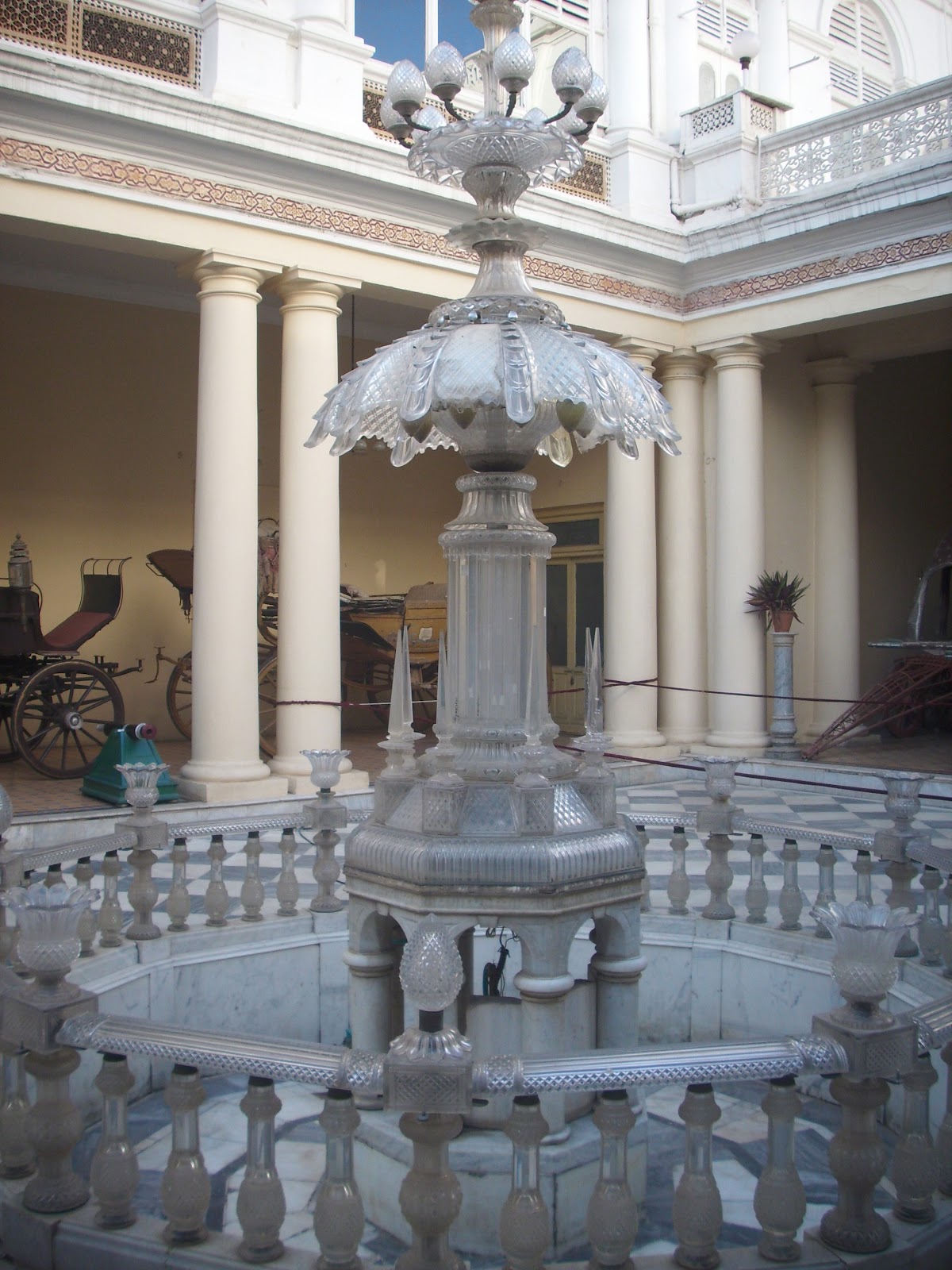
After we had finished eating, we set off for the famed Jai Vilas Palace and Scindia Museum.  The palace had been built in 1874 as a place of residence for the Scindia family, who were the Maharajas of Gwalior.  Only a small section of the palace has been opened up to the public (the rest of the palace still serves as a home to the current Scindia Maharaja and his family) but that small section was enough to demonstrate the enormous wealth and extravagance of India’s ruling families.  There were walls painted in pure gold, a 3.5 ton chandelier, an indoor swimming pool with multiple diving boards, a miniature train that carried food, beverages, and cigars around the dinner table, and much, much more that was so opulent as to be almost absurd, especially when contrasted with the abject poverty of so many Indians.  Once again, I was reminded of the paradoxes of India, and of the huge gap between the rich and the poor. 

Walking up to the palace

Inside the courtyard.

This is the section that the family lives in.

Why not collect old military knick-knacks?

A little dark, but here is the swimming pool and diving board.

A cradle decked out for the idol of the baby Lord Krishna for his birthday, Janmashtami,

A modest fountain

A buggy

The next day, my dad and I decided to go and see the tombs of Mohammed Gaus, a Muslim Saint, and Tansen, one of India’s most revered classical singers, who had been a favorite of the Mughal Emperor Akhbar.  The tombs were beautiful, but clearly not frequented by many tourists, at least judging by the small following we soon developed.  Nevertheless, we had an enjoyable time walking around, and admiring the monuments.  The tomb of Mohammed Gaus was certainly bigger and more showy than that of Tansen, but I was somehow more drawn to Tansen’s tomb, possibly due to Tansen’s role in the story I had read with my 6th graders.  Of particular interest was the Tamarind tree growing next to Tansen’s grave.  According to local superstition, chewing the leaves of this tree will greatly enhance ones singing voice.  I chewed on a few leaves, an act which left a very  bitter taste in my mouth, but if it brought me the blessings of the great Tansen, then who was I to complain.

The tomb of Mohammed Gaus

The Tomb of Mohammed Gaus, side view

Tansen's Tomb

Several hours later (also several hours after our train was supposed to leave!) we were on a train bound for Delhi’s Hazrat Nizamuddin Railway station.  Our trip had been short, but productive, and very informative.  I think we were both very happy to have seen an Indian city that was somewhat off the tourist radar, and definitely outside of the tourist packed “Golden Triangle” (Delhi, Agra, Jaipur).  Before my dad had even arrived, many of the teachers at my school looked at me quizzically and said, “Gwalior?  Why would you take your dad to Gwalior?  There’s nothing there! Take him to see the Taj!”  Despite the skepticism we encountered, I think both my dad and I were very satisfied with the choice we had made, and would definitely recommend it to any other travelers looking to venture away from India’s main tourist circuits!